GitOps
What reconciles itself, what does not, and where the boundary actually falls
The Overview says the directory decides how a file reaches the machine. There are three regimes rather than two, and the third is the one that gets forgotten.
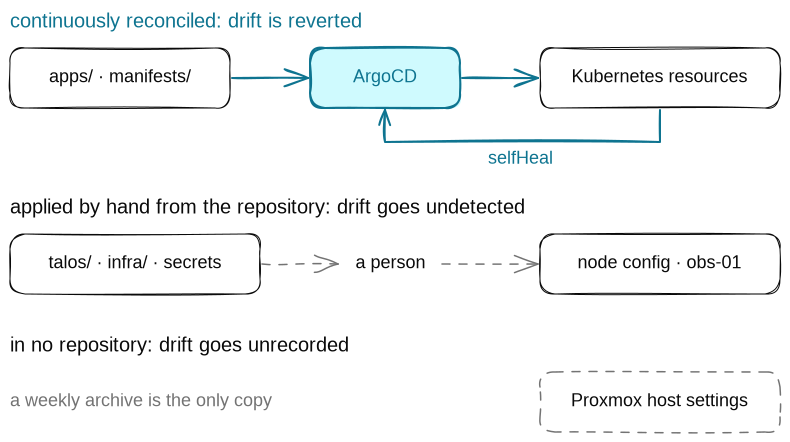
Only the first has an arrow that closes. The boundary is not whether something is in Git but whether reality converges on Git by itself.
The app-of-apps
One root Application reads apps/children/. Most children there point at an upstream Helm chart or at a directory of plain manifests under manifests/. Adding a component is one new file, plus any manifests it points at. Removing that file removes the Application, because the root prunes, but what the Application created goes with it only if the child carries the finalizer described below.
So the bootstrap layer is not self-hosting. The one file that defines everything else is the one file with no safety net.
What ArgoCD does not manage
argocd/installs the thing that reconciles, so it has to exist before anything else can be reconciled. ArgoCD could manage itself afterwards, and here it does not. A few settings are patched on top of the shipped manifest, and nothing reverts them, so re-running the install line is what would lose them.- Encrypted secrets are applied by hand before the Application that needs them, since ArgoCD here has no sops plugin.
talos/is machine configuration, applied withtalosctl. It defines the node, and a hand change on the node stays until someone notices.infra/covers the guests, the monitoring container and the timers pushed to the host. Its create scripts run once and its deploy scripts run when someone runs them. There is deliberately no Terraform: a state file is a poor trade for creating a VM and a container once.
Beyond those sits the Proxmox host. Storage, the imaging job and notifications are in no repository. A change there is undetected and unrecorded, and a weekly archive of the configuration, pushed out with the backups, is the only copy. This is a decision rather than an oversight: the host was put outside Git and left to backups. Its cost is that nothing compares what is there with what was intended, so drift shows up when it breaks something.
Home Assistant is outside all of it. Its configuration is exported daily to a separate repository, which makes that a record of what changed rather than a way to change anything.
Secrets
sops with age. The encrypted file is committed, the key is not, and applying it is a manual step.
There are two keys with a deliberate asymmetry. A key belonging to obs-01 opens that container’s own credentials and nothing else, so compromising monitoring does not reach the cluster. The workstation key opens everything, and exists in one place. Losing it leaves the repository as ciphertext. The offsite backup’s keys have a password manager copy for exactly that case; this key does not, and that gap is still open.
Traps
- Deleting an Application does not cascade unless the finalizer is present. Without it the Application disappears and what it created keeps running, with nothing in the UI to say so.
- Large CRDs need
ServerSideApplyhere.Replaceis the other way out. Client-side apply stores the whole manifest in an annotation capped at 262144 bytes, and several operator CRDs exceed that alone. - A repository rename hides an incomplete migration. The redirect keeps everything syncing, so the failure you would want to see never happens.